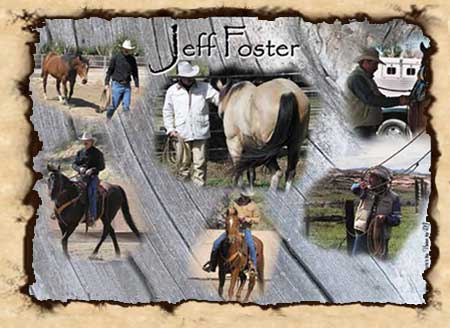
Colt Starting • Problem Solving • Training • Clinics


"...I work horses so they understand what people are asking of them...
I also work with people, so they know how to ask".


Jeff's Philosophy

The horse is a prey animal and we are predators. The horse knows this but at times we forget. My way of working a horse is to teach, not train and to ask, not demand. The results sure do turn out for the better. I would much rather get on a horse that understands me than one that fears me.

I want to give a horse a job and he wants one as his performance will show. Whatever the problem is, I present the horse with a situation and ask him to work his way through it, with me guiding him so that I can make the corrections when needed. Sometimes he guides me. I learn everyday and hope I never stop. We need to establish a working relationship with the horse and one that is agreeable to both of us.

I am sure that we all enjoy horses when they know where to put there feet. The hindquarters are the "engine" and we can drive them or shut them down. One should be able to take a horse on the ground and have him put his feet wherever you want them as this is what you will do in the saddle. You will pick up a foot from the saddle and place it where you want to.

The horse being a prey animal is quite knowledgeable of fight or flight and we have to give him reason to do neither. In doing so the end result I strive for, is not that only I can be a partner with your horse but that you can as well


Jeff's Bio

Horses have been and shall continue to be a major part of my life. I grew up around horses. I started shoeing, on my own, at 16 when it was $12.50 a head. I went on to apprentice at a race track and studied with an Amish man to learn the forge and to drive teams. During this time to further support myself I rode colts and horses that people could not seem to get along with. Following that, somehow, I wound up at the Grand Canyon riding, shoeing and packing the mules.

When I was working some of the smaller outfits in California and Arizona, in my late teens, I used to be so consumed by the stories the “old timers” would tell of the days that were. I decided that I wanted to see what the words meant so I saddled up my gelding and rode him from California to New York. The trip took a year and a day and was over 3000 miles. The “old timers” were right. It was a great way of life, hard but great. It was myself, my horse, a stray dog and the land and that was all I wanted or needed.

I had learned of horses from the old school. Often at some of the places I worked there was no one around to teach me otherwise than the rough stock I was accustomed to. I have been kicked, bitten, run over, runaway with, dragged and stomped, just to name a few things. Some of these “mishaps” led to visits to the MD all while I was wrangling, cowboying, shoeing, floating teeth, packing and riding colts.

I started to work some horses on my own and began putting the pieces together. I thought of the groom at the race track who led a race horse to me to be shod. Out of his stall the horse would be “high” and ready to run. The groom would step into the flanks and send the horse to the left and right a few times and the horse would calm down and stand for me. It was disengaging the hindquarters. The more “seasoned” cowboys who, I would see and hear from would tell me if I got into trouble with a horse when mounted, to try and prevent the wreck, take his nose towards your thigh, bend him and turn him so that his hind end was crossing over. This again was disengaging the hindquarters, the” motor” of the horse. I learned that if you were fighting the horse, then odds were he had no idea what you wanted.

All this was long before clinics were the clinics we see today. There were no videos, no dedicated TV station, no short cuts or gimmicks. Experience, patience and horses were my teachers. My classroom was and still is the open land. My teachers were horses and the folks who rode them for a living. Whenever I had the opportunity to wrangle the remuda, I would watch the way their “society” worked. One really had to learn by seeing and observing. If you watch horses interact and are around them long enough you will see how they “drive” each other away from the herd or show aggression and defeat. We can learn how they become the dominant in the herd and the way they move and why they move in the manner they do
and we can incorporate that into our horsemanship It is a great education and a person would do well to speak (body language) to the horse so that he understands what it is you are asking and you can do so just as one horse does to another. We can understand why a horse needs to yield, bend and learn where to put their feet. The horse knows what to do we have to know how to ask.


Horses are a way of life and I do not ever wish to paint a perfect world of the horse. They can be dangerous and I always say that a bad habit can be changed but when it becomes a way of life it is a time consuming effort. I have learned by doing and listening to horsemen at every chance I had. My education came not only from the horse that has bucked me off or run me over but also from the horse that took me through the Continental Divide or shared the quiet of the sunset with me – the good and the ……. well it was all good and still is.


Home Schooling Applied Methods A Mustang's Trail Philosophy & Bio
Gallery
A Tribute to a Fine Horseman!  Contact Jeff

Copyright©2005 - 2008, Jeff Foster Horseman
Created & maintained by
SoCalEquine.com